Challenges faced
The most challenging issues we faced in this cultural conversion project were lack of test data due to information security policies, collaborated services with different companies, high number of incoming calls during the day, unexpected change of priorities and poor understanding of product teams of test automation and quality.
Waterfall methodology was applied in the projects and there was a short amount of time for testing. In terms of the test culture, testing was only the responsibility of a particular person or group. Product teams did not have a specific test scope, test plan and regression test set, and setting up a test scope was considered as an unnecessary workload.
Solutions Designed
We formed/generated a 4-stage plan to overcome these problems. In the beginning, we initiated the DevOps process, then continued by converting the process to Agile. By determining and prioritizing our team’s duties, we started testing and quality transformation process.
In order to improve code quality, we guided teams to dissolve issues in SonarQube projects on a sprint basis and to analyze the code written by each developer in the team by installing the SonarLint plug-in to its IDE. In this way, we ensured that the code quality in the projects increased continuously. We also defined a specific quality gate for each project, ensuring that no bugs or technical debts were allowed in the newly written code. Today, there are no critical or blocker bugs left in most of the projects and the number of problematic issues in the projects continues to decrease regularly.
Test data generation and virtualization services were written for solving test data problems and reducing dependence on the third parties.
Apart from all this, the most challenging issue for our team was that product teams did not adopt the test & quality process and saw it as an unnecessary workload. We followed two methods to overcome this; we first determined the level of each team by creating test automation and quality maturity levels.
Secondly, we prepared road maps specific to the team structure by working together with product teams. In order to motivate product teams in this process and make this process more fun, we turned it into a gamified process.
We have realized the risks after the structural test transformation and started managing effectively. We ensured that our product is being developed via a test-driven process
- Ömer UYAR, CEO, Intertech
Results implemented
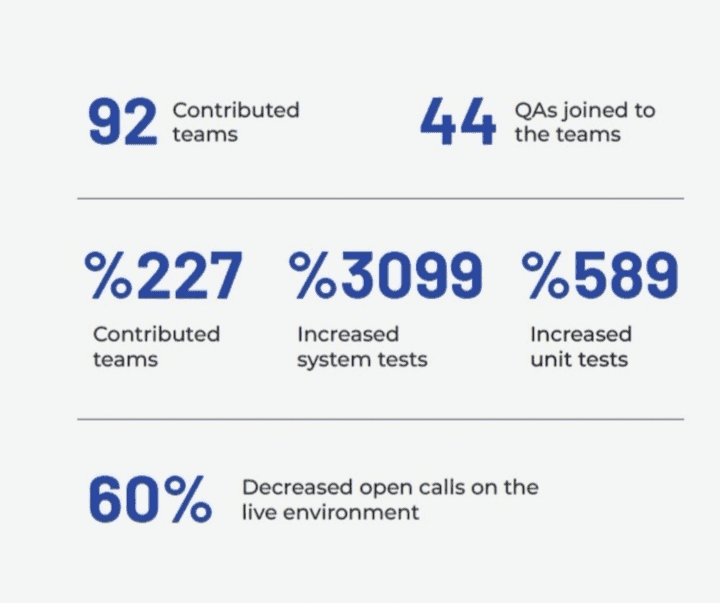
Test automation & quality process were adopted as a core company culture. Product teams acknowledged the importance of adopting the test automation & quality culture.
Monolithic projects have been transformed into micro-service architecture and eventually a modern architecture was established. The environment became also suitable for writing unit tests and integration tests. We have achieved 80% code coverage in these projects. All the teams we worked with had a regression plan and they ran these plans on every sprint. All pre-written UI tests ran regularly with our Testinium product. In many projects, bug and vulnerability scores have been reset or decreased to almost zero. Thanks to the quality gates which were specifically defined for projects, the increase in technical debt and the arrival of new bugs were prevented. As a result of CI / CD processes, all of our projects were automatically tested after they were built.
Ensuring the performance of running 13.000 test scenarios with our Testinium product.
Increasing the parallelism of UI tests from 24 to 48.
Transitioning Test Automation runs from IEXPLORER to Microsoft EDGE.
Completing the Test Automation Node machines’ transition project from WIN10 to Server 2022, thereby increasing the number of nodes from 100 to 200. Additionally, logging in with two users on each node and adding 400 test environments to the hub for each node.
Enabling the mobile applications of Mobildeniz, FastPay, and DenizBank AG to run on the device park via s2s VPN between Testinium and Intertech.
All Project settlement went on live within one year and a half time period.