
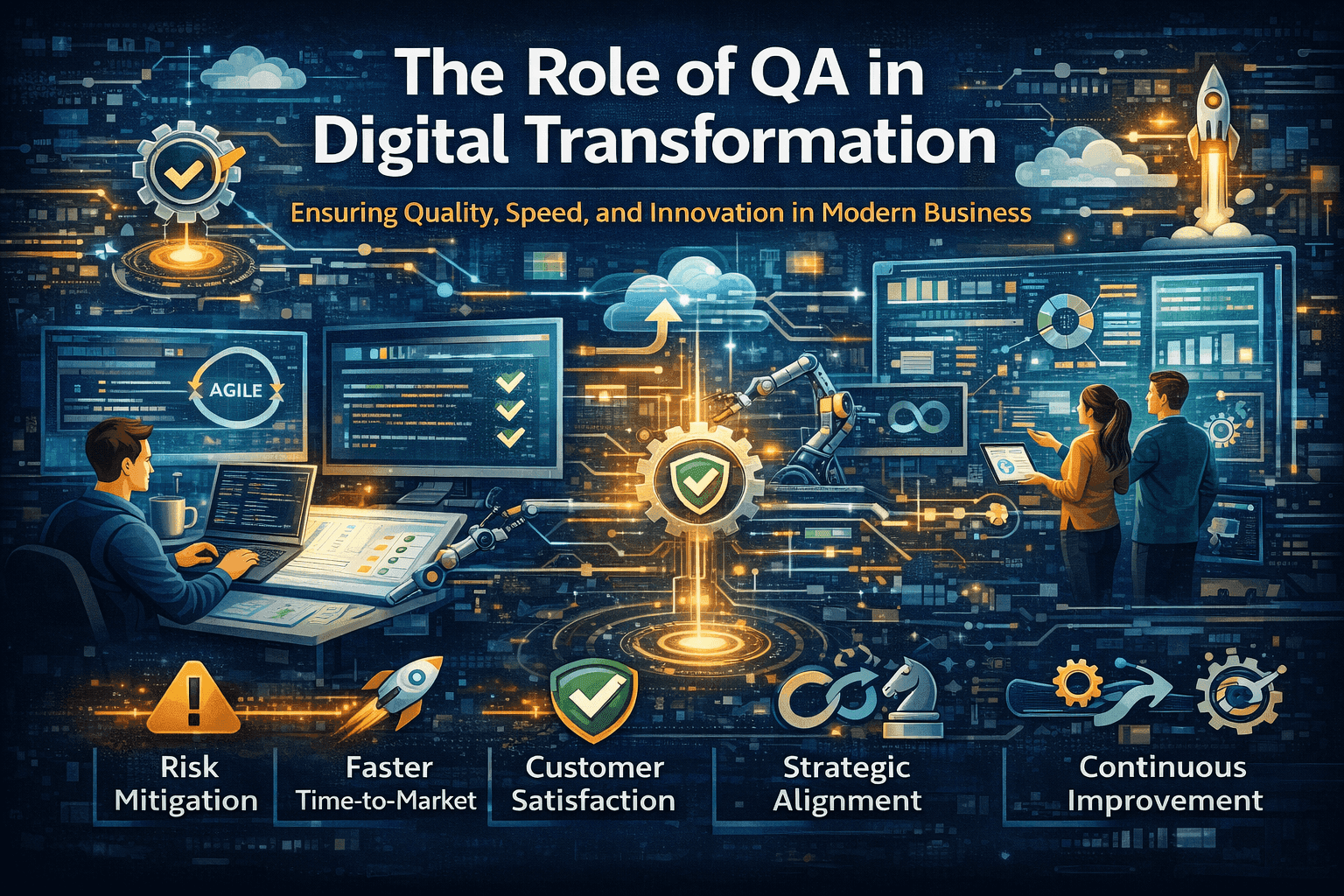

Digital transformation has become more than just a technology upgrade for modern businesses; it is a strategic imperative that improves customer experiences, accelerates processes, and enables innovative products to reach the market faster. In this transformation journey, Quality Assurance (QA) plays a critical role. Concepts like 'QA in software transformation quality assurance digital strategy, QA and agile delivery, QA for innovation importance of QA in digital change' are now central in the tech world.
What Is Digital Transformation in Software Development?
Digital transformation in software development is not just about migrating legacy systems to modern platforms. It encompasses cloud-based architectures, AI-powered solutions, data-driven business models, and customer-centric designs. Transformation is not only about faster software delivery but also about high-quality, secure, and continuously improved solutions. This is where QA ensures that the transformation progresses safely and efficiently.
Why QA Is a Key Enabler of Digital Transformation
In digital transformation projects, quality assurance is often one of the most critical success factors.
- Risk mitigation: QA identifies potential security vulnerabilities and performance issues early in the process.
- Enhanced customer satisfaction: User-focused testing ensures the transformation delivers real value.
- Strategic alignment: QA bridges business goals with software quality, forming a foundation for an effective digital strategy.
By integrating QA from the outset, organizations can reduce costly rework and ensure transformation objectives are met.
Shifting QA from Gatekeeper to Strategic Partner
Historically, QA teams were seen as 'gatekeepers' performing tests at the end of the process. However, with digital change, QA has evolved into a strategic partner that adds value throughout the development lifecycle.
- It defines quality standards during requirement analysis.
- It provides continuous testing and feedback in Agile sprints.
- It collaborates with developers toward shared goals.
QA is no longer a final checkpoint but a strategic contributor to the entire digital transformation process.
How QA Contributes to Faster Time-to-Market
One of the main goals of digital transformation is faster delivery to market. QA contributes to this by:
- Automation: Reducing manual testing and accelerating validation.
- Agile delivery: Offering continuous feedback loops.
- Early defect detection: Shortening the development cycle by catching issues sooner.
As a result, high-quality software reaches customers faster, supporting competitive advantage.
The Role of Automation and CI/CD in Modern QA
Automation and CI/CD (Continuous Integration / Continuous Deployment) have become essential in modern QA practices.
- Test automation accelerates regression testing and minimizes human error.
- CI/CD integration ensures code changes are automatically tested and deployment-ready.
- QA teams become strategic contributors, designing automation scenarios and monitoring the process rather than just executing tests.
Quality at Every Stage: From Development to Deployment
Quality is no longer limited to the delivery stage; it must be embedded across the entire software lifecycle.
- Development stage: Unit tests and code reviews ensure robust foundations.
- Testing stage: Functional, performance, and security tests validate software readiness.
- Deployment stage: Continuous monitoring and user feedback maintain quality in production.
This quality-first culture ensures that QA is an ongoing commitment rather than a single-step task.
How QA Teams Can Support Innovation and Agility
Digital transformation also requires innovation. QA teams play a critical role in enabling it:
- They ensure new technologies are safely implemented.
- They provide controlled testing environments for experimental features.
- Through QA for innovation, they support both quality and agility.
This approach allows organizations to experiment quickly while minimizing risks to user experience.
Common Challenges QA Faces During Transformation
QA encounters several challenges during digital transformation:
1. Integration with legacy systems: Older software may not support modern testing frameworks.
2. Cultural resistance: Shifting QA from a gatekeeping role to a strategic partner takes time.
3. Misapplied automation: Poorly designed automation can create extra work instead of value.
4. Resource constraints: Skilled professionals and advanced tools are essential for effective QA.
Understanding these challenges enables organizations to make informed decisions and reduce transformation risks.
Building a QA Strategy Aligned with Digital Goals
To succeed in digital transformation, a QA strategy must align with organizational digital objectives:
- Establish clear quality metrics.
- Integrate QA within Agile and DevOps culture.
- Adopt continuous improvement principles.
- Measure both software quality and customer experience.
By doing so, QA becomes central to the digital strategy and ensures the transformation delivers measurable value.
Conclusion
Digital transformation is not just about adopting new technologies; it is about reshaping organizational culture, business models, and customer experiences. In this context, QA in software transformation guarantees not only software quality but also strategic alignment, customer satisfaction, and innovation.
Ultimately, QA is no longer merely a 'bug-finding' team. It is a strategic actor that directly impacts the speed, quality, and success of digital transformation initiatives.
